Buyer Guide
How to Start a Private Label Sex Toy Brand: Step-by-Step Buyer Guide
Short Answer
Follow a practical B2B process from product selection and samples to branding, packaging, approval, production, quality review and launch.
Launching a private-label intimate wellness brand is mainly a sequence of commercial decisions: who the product is for, which category fits the channel, how much customization is justified, and what must be approved before production. Buyers who settle those decisions in the right order reduce sample revisions, packaging rework, and avoidable delay.
This guide is written for importers, retailers, Amazon sellers, distributors, and emerging brand teams preparing a first commercial project.
Step 1: define your market position
Start with the buyer and channel, not a long list of products. A specialist retail collection, a mass-market online listing, and a premium gift program may need different product functions, packaging, price architecture, and content.
Write a one-page brief that answers:
- Which country or marketplace will receive the product?
- Who is the target customer?
- Will the product be sold by a retailer, distributor, marketplace, or direct brand site?
- What is the target retail position and target landed cost?
- What problem should the assortment solve for the channel?
- Is the first order a market test or the beginning of a broader range?
Do not build a premium package around a product that cannot support the target retail price. Conversely, do not weaken a premium position with packaging, instructions, or imagery that looks inconsistent across the range.
Step 2: choose a product category
Select one category that fits the target customer and operational capacity. JWELL provides access to 300+ available product options across multiple intimate wellness categories, but a first launch does not need to represent the full range.
Use the product catalog to compare:
- Vibrators and wands
- Suction and air-pulse products
- App-controlled and wearable models
- Male wellness products
- Anal and prostate models
- Dildos and specialty products
For each candidate, consider function clarity, product size, power or charging method, available specifications, package dimensions, color direction, and how easily the buyer can explain the product in its channel.
Step 3: shortlist existing models
Existing models are normally the lowest-risk route for a first project. They allow the buyer to evaluate a physical sample before investing in a custom structure. Shortlist two or three models against the same criteria rather than requesting a large, unfocused sample set.
| Comparison point | Buyer question |
|---|---|
| Product fit | Does the function and format suit the intended customer? |
| Commercial fit | Can the expected product and packaging cost support the target channel? |
| Technical clarity | Are the model-specific specifications available for review? |
| Branding | Is there a practical logo area and suitable application method? |
| Packaging | Can the product be presented and protected in the required format? |
| Documentation | What information is available, and what must be prepared for the destination market? |
Step 4: choose private label or custom development
These routes should not be treated as interchangeable. Review the JWELL private-label process before deciding how much product development the first launch needs.
- Private label: use an existing model with an approved logo, color option, and packaging program.
- Product modification: change selected functions, components, motor options, surface finish, or feasible structural details of an existing model.
- Custom development: develop a new concept through industrial design, technical review, prototypes, tooling, and pre-production validation.
Product modification and full custom development are subject to model feasibility, engineering review, project quantity, and development cost. A first-time brand usually benefits from proving its positioning with an existing model before funding custom tooling.
Step 5: understand the MOQ structure
Ask for separate quantities for the existing product, logo, color and packaging. Standard MOQ is 100 pieces with JWELL standard packaging; private-label, logo, color and packaging customization each have a MOQ of 500. custom development has an MOQ of 100 pieces when the buyer pays for tooling.
These are working references, not guarantees. Read the private-label MOQ guide before defining your first-order quantity.
Step 6: define the branding
Prepare a vector logo and a simple brand usage guide. Logo methods may include silk printing, laser engraving or etching, and other model-dependent methods. The correct method depends on product material, surface, structure, and logo design.
Confirm:
- Logo file format and minimum line thickness
- Available print or engraving area
- Logo color and contrast
- Position and orientation
- Expected appearance on curved or soft surfaces
- How the logo sample will be approved
Step 7: develop the packaging
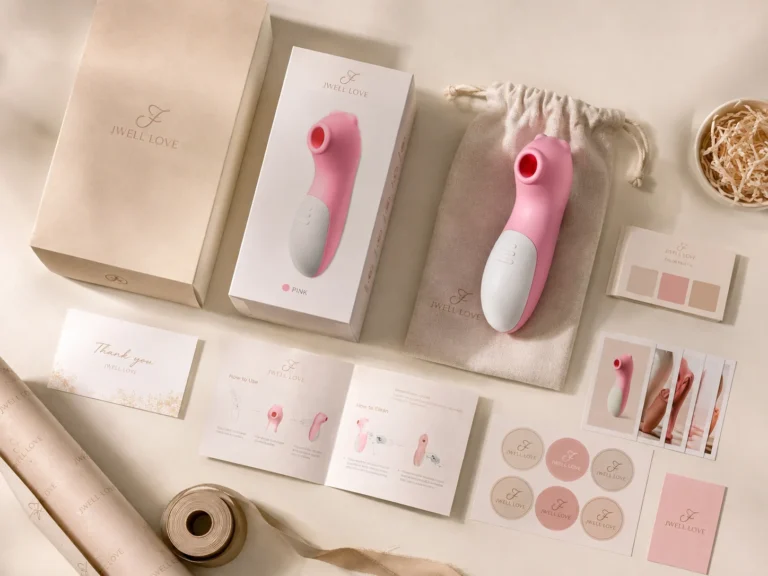
Packaging must protect the product and communicate the brand, but it also carries operational information. Depending on the project, options may include a printed paper box, gift box, custom insert, label, instruction manual, barcode or sticker, and outer-carton requirements.
Define the sales channel before selecting the structure. A retail shelf needs clear front-panel communication; an e-commerce shipment needs efficient protection and dimensions; an Amazon FBA project must follow the buyer’s current labeling, prep, and shipment instructions.
Use the existing private-label packaging checklist to prepare artwork and approval points.
Step 8: request focused samples
After shortlisting, request the specific samples needed to compare the models. Standard sample quantity is 1–5 pieces and sample lead time is 5–7 days. Confirm availability, sample charges and shipping terms for the exact model.
Evaluate the product as a buyer, not only as a user. Record:
- Model and sample version
- Appearance, finish, seam, controls, and accessories
- Function sequence and charging behavior
- Instructions, labels, and package protection
- Requested corrections
- Approval status and date
Step 9: review compliance and documents
Requirements can depend on the product, electronics, battery, materials, claims, destination market, and sales channel. Do not ask for “all certificates.” Request model-specific information and discuss the destination-market requirements with qualified compliance advisers or testing partners where needed.
The buyer document guide explains what to request before sample and order approval.
Step 10: approve product and artwork
Before production, establish one controlled approval pack. It should include the product model and specification, approved sample reference, color, logo position and method, packaging dieline, artwork files, manual, labels, barcode information, carton markings, quantity breakdown, and any agreed inspection points.
Verbal approval is not enough for a multi-part private-label project. Use dated files and written confirmation so the buyer, production team, printer, and inspection team refer to the same version.
Step 11: production and quality review
A typical OEM/ODM production reference is approximately 15–25 days, depending on the model, customization, packaging, artwork approval, sample confirmation, quantity, and production schedule. This is not a fixed delivery promise.
Use the published OEM/ODM buying guide to compare an existing model, selected product modification, and full custom development. Agree on the review method before production finishes. It may include product appearance, function sampling, quantity, packaging, labels, accessories, manuals, and available documents. Visit the quality and compliance page for the JWELL review framework.
Step 12: shipping and fulfillment
Confirm the Incoterm, destination, freight method, carton dimensions, gross weight, shipping marks, and required transport information. Products containing batteries require correct transport preparation and carrier review. Shipping time is separate from production time and should be quoted against the actual route.
Amazon and FBA considerations
JWELL may support shipment to Amazon FBA destinations where the buyer provides the required shipping and labeling information. The seller remains responsible for confirming current marketplace, product, listing, barcode, prep, labeling, and shipment requirements through official Amazon Seller documentation.
JWELL does not guarantee Amazon account approval, listing approval, category approval, or sales performance. Prepare the marketplace, destination, seller-provided labels, packaging instructions, and carton plan before production is released.
A practical first-order example
An emerging brand shortlists three existing models from one category. It orders samples, evaluates function and presentation, then selects one model in a standard color. The buyer approves a model-appropriate logo and develops a branded paper box, insert, English manual, and barcode panel. After the physical product and artwork are approved, the buyer confirms the first commercial order and an agreed pre-shipment review.
This route keeps the first project focused. The brand can consider custom colors, function changes, or a custom product after it has real channel feedback.
Launch checklist
- Market positioning approved
- Product category selected
- Candidate models compared
- Samples reviewed
- Private label or development route selected
- MOQ and quotation confirmed
- Logo method and position approved
- Packaging and instructions approved
- Model-specific documents reviewed
- Production and inspection plan confirmed
- Shipping and destination requirements confirmed
- Launch content and inventory plan prepared
Frequently asked questions
Should a new brand begin with private label or a custom mold?
Private label is normally the more practical first-market test because the product structure already exists. Custom tooling is better suited to a differentiated concept with a clear technical brief, development budget, quantity plan, and engineering review.
How many models should I sample?
There is no universal number. Two or three carefully selected models in one category are often more useful than a large mixed sample order because they can be compared against the same buyer and channel criteria.
Can the product and packaging have different MOQs?
Yes. Product assembly and packaging printing are separate processes. Confirm both before approving the order.
Can JWELL ship to Amazon FBA?
JWELL may support shipment to buyer-designated FBA destinations when the buyer provides current shipping, prep, carton, and labeling requirements. Marketplace approval remains the seller’s responsibility.