Buyer Guide
Private Label Sex Toy MOQ Guide: How Much Do You Need to Order?
Short Answer
Learn how product, logo, color, packaging and custom-development MOQs differ, with qualified working references for private-label buyers.
Minimum order quantity is rarely one number. A buyer may be able to purchase an existing model in a standard color at one quantity, while logo application, a custom color, printed packaging, or structural development each creates a different production threshold. Treating all of these as a single “MOQ” is a common reason early quotations become confusing.
JWELL’s current policy separates a 1–5 piece sample from a standard MOQ of 100 pieces with JWELL standard packaging. Private-label, logo, color, and custom-packaging policy MOQ is 500 units; custom-development MOQ is 100 pieces when the buyer pays for tooling. The actual MOQ for an existing SKU may vary with the product, material, packaging, customization, and production requirements and must be confirmed in the model-specific quotation.
What does MOQ mean for private-label sex toys?
MOQ means minimum order quantity, but a useful quotation separates the commercial requirements behind that minimum. Buyers should ask which MOQ applies to each part of the project.
- Product MOQ: the minimum quantity for an existing finished model, usually in an available standard specification.
- Logo MOQ: the threshold for applying a buyer’s logo by a model-appropriate method such as silk printing or laser engraving.
- Color MOQ: the quantity required to prepare a non-standard product color or finish.
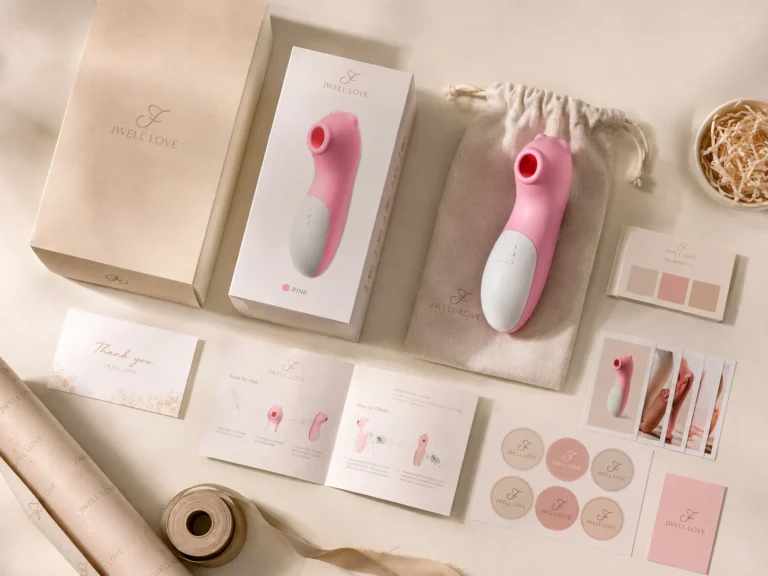
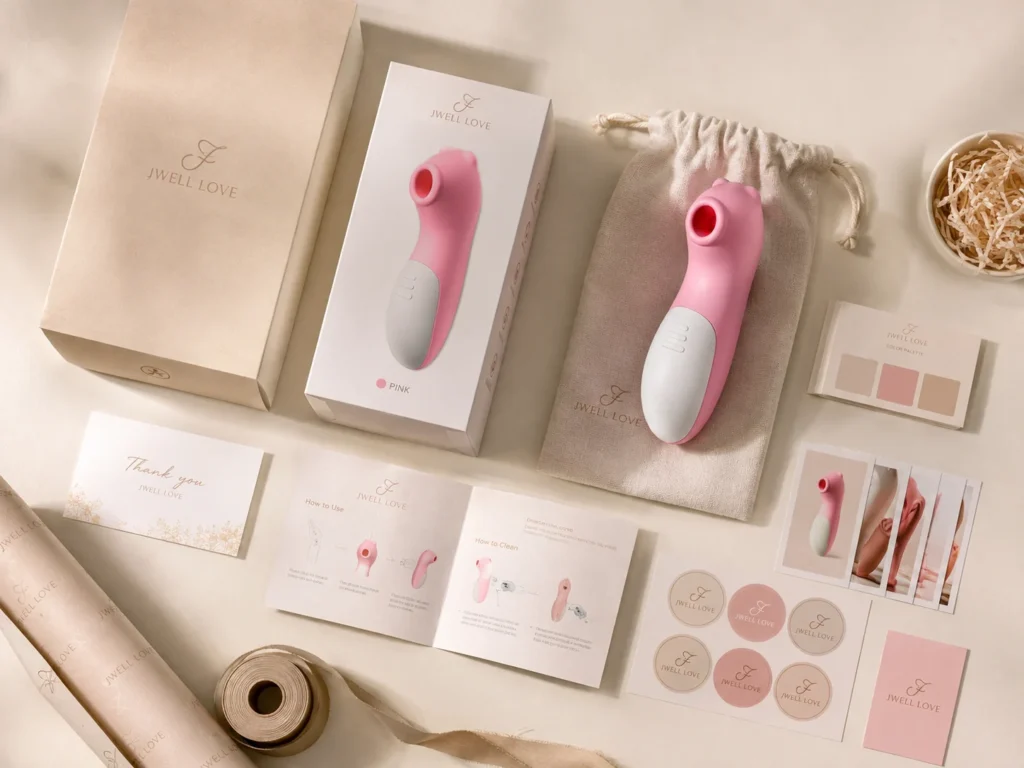
- Packaging MOQ: the printing or converting minimum for boxes, inserts, labels, manuals, or other branded packaging components.
- Custom-tooling MOQ: a project-specific commercial quantity used to justify engineering, prototyping, tooling, and production setup for a new structure.
These thresholds can differ within one order. For example, a product may be available at a relatively low quantity, while the printer requires a larger run for a custom box. The buyer can then decide whether to use stock packaging for a first test, order additional empty packaging, or move to a larger commercial quantity.
Typical MOQ scenarios
| Project route | What changes | MOQ approach | What to confirm |
|---|---|---|---|
| Existing product, no customization | Standard model, color, and packing | 100 pieces with JWELL standard packaging | Actual SKU MOQ, stock status, carton quantity, and available color |
| Basic logo customization | Logo applied to an existing model | Private-label/logo policy MOQ: 500 units | Material, printable area, logo size, method, and artwork |
| Custom color | Non-standard housing or silicone color | Color policy MOQ: 500 units; confirm exact project | Color reference, component minimums, tolerance, and sample approval |
| Custom packaging | Printed box, insert, label, or manual | Custom-packaging policy MOQ: 500 units | Box structure, print process, finish, language, and file readiness |
| Function modification | Selected motor, control, component, or firmware changes | Project-specific | Model feasibility, engineering scope, validation, and component supply |
| Full custom tooling | New product structure and molded parts | Custom-development MOQ: 100 units when the buyer pays for tooling; feasibility and quotation required | Development cost, tooling, target quantity, testing, and ownership terms |
Why does MOQ change?
Component purchasing
Motors, batteries, control boards, silicone parts, plastic housings, charging components, and accessories can have their own purchase or production minimums. An existing model uses an established component set; a new function or color may require a separate component run.
Printing and branding setup
Logo application requires artwork preparation, positioning, fixtures, screens, or machine setup. The economical threshold depends on the method and product surface. Silk printing and laser engraving are not interchangeable on every material, so the model must be reviewed before the MOQ is confirmed.
Packaging production
Printed packaging has fixed setup work before the first usable box is produced. Dielines, printing plates, color control, finishing, cutting, inserts, and manual printing can each affect the minimum. A simple label normally has a different threshold from a rigid gift box with a formed tray.
Color production
A custom color can involve pigment matching across silicone and plastic parts, trial samples, cleaning, and a dedicated production batch. Buyers should provide a color reference and approve a physical sample where color consistency is commercially important.
Assembly efficiency and quality control
Production lines require setup, work instructions, inspection standards, and packaging preparation. Very small runs can create disproportionate setup and inspection cost, especially when the order contains many color or packaging variants.
Tooling and development cost
A new structure requires more than a larger order. Industrial design, engineering review, prototype work, molds, electronic development, waterproofing review, and pre-production validation may all be required. The commercial quantity is therefore confirmed after technical evaluation, not selected from a universal chart.
JWELL working reference
JWELL provides access to 300+ available product options across multiple intimate wellness categories. Buyers can use these existing models to reduce development work and compare practical starting routes.
- 1–5 samples can be requested for evaluation; sample terms and availability are confirmed for the exact model.
- Standard MOQ is 100 pcs per model with JWELL standard packaging; custom packaging, logo and color start at 500 pcs, and custom tooling starts at 100 pcs when the buyer pays for the mould.
Send the exact product model whenever possible. A category-only request can receive a broad answer; a model-specific request allows the team to check material, branding area, available colors, packing format, and production conditions.
How startups can reduce first-order risk
- Start from an existing model. This avoids unnecessary structural development before market demand is known.
- Keep the standard color. A standard color removes one approval step and may reduce component minimums.
- Customize the logo first. Basic brand application can create a recognizable product without changing the engineering.
- Use practical packaging. A printed paper box, label, or sleeve may be more suitable for a first order than a complex rigid gift set.
- Test samples before artwork is finalized. The physical product determines box dimensions, insert requirements, label position, and manual content.
- Delay structural changes until the product route is proven. Product modification and custom molds are better considered after target cost, functions, and expected volume are clear.
A practical first inquiry
Instead of asking “What is your MOQ?”, send a request such as:
We are evaluating model JW-SXX for the US retail market. Our first-order target is 500 units in one standard color. We need a one-color logo, a printed paper box, an English manual, barcode space, and a sample before confirmation. Please advise the separate MOQ and setup requirements for the product, logo, and packaging.
This gives the quotation team enough information to identify which part of the project controls the minimum.
Questions buyers should ask before requesting a quote
- Is the stated MOQ for a standard product or a customized product?
- Does the logo process have a separate setup charge or minimum?
- Can standard colors be mixed, and does each color have a minimum?
- What packaging format is included in the product quotation?
- Does the printed box, insert, label, or manual have a separate MOQ?
- What files must the buyer supply before a packaging quotation is final?
- Is a pre-production sample required for logo, color, or packaging approval?
- Which specifications are confirmed for the selected model?
- What changes would move the project from private label to product modification?
- Which development charges and commercial quantities apply to custom tooling?
Frequently asked questions
Can I order below MOQ?
The sample-quantity policy is 1–5 units. A smaller existing-product order depends on the exact SKU and quotation; do not assume that logo, color, or printed packaging can run below their 500-unit policy MOQ.
Is packaging MOQ different from product MOQ?
Yes. Packaging is made through a separate printing and converting process. The product may be available at one quantity while the customized packaging supplier requires another. Both quantities should be shown clearly in the quotation.
Can I mix colors?
That depends on whether the colors are standard, whether components are available, and whether each color meets the model’s production minimum. Send the requested quantity by color for review.
Does a custom mold have a different MOQ?
Yes. The custom-development MOQ is 100 pieces when the buyer pays for tooling. Tooling still needs a model-specific engineering, cost, feasibility, and quotation review; this quantity alone does not approve a new structure.
Can I order samples first?
The sample-quantity policy is 1–5 units. JWELL’s sample lead-time policy is 5–7 days; exact availability, dispatch and delivery details are confirmed for the chosen model and destination. Sample charges are discussed for the project.
Plan the quotation around your real project
Review the JWELL product catalog, compare the relevant vibrator and wand models or other product categories, and read how the private-label process works. The published packaging checklist and OEM/ODM buying guide can help buyers separate packaging and development requirements from the product quantity. A useful MOQ answer should connect the selected model, quantity, branding, packaging, and target market rather than repeat one universal number.
Use the Sex Toy OEM RFQ Checklist to separate product, color, logo, packaging and development quantities before requesting MOQ and pricing.